Understanding Collagen
“The roles of key collagen types in skin structure, ageing, and regeneration”
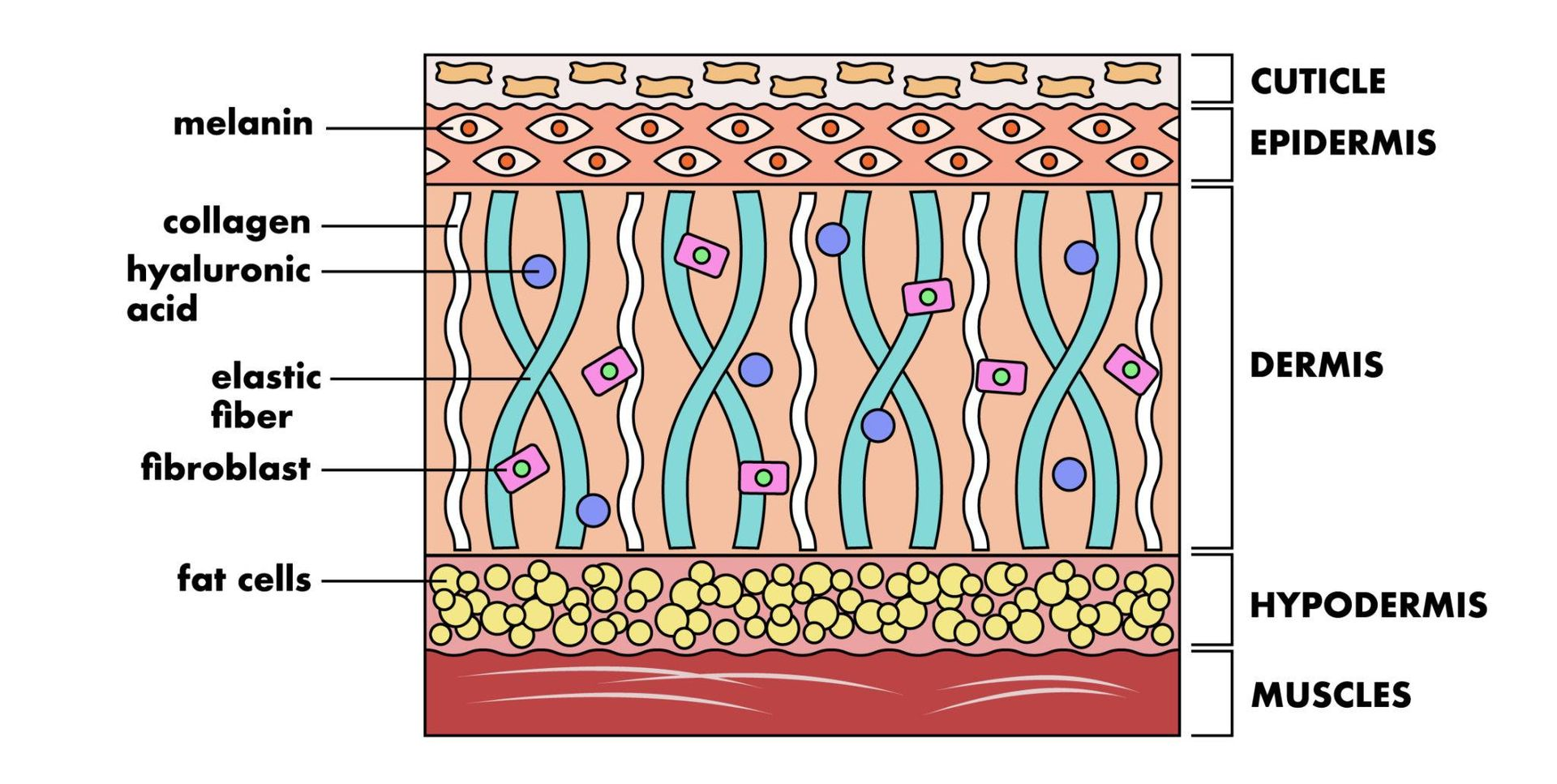
Collagen is often talked about as though it’s a single substance, but in reality it’s a
family of proteins, each with a specific structure and role.
Human skin contains
multiple collagen types, working together to provide
strength, elasticity, resilience, and structural integrity from the surface down to the deeper layers.
Understanding which collagen does what is essential for appreciating how skin ages, why it weakens over time, and why modern skin treatments often focus on supporting collagen health rather than simply “adding volume.”
What is collagen, in simple terms?
Collagen is the most abundant protein in the human body. In the skin, it acts as:
- a scaffold that gives strength and firmness
- a framework that supports elastin, blood vessels, and cells
- a communication platform between cells and the extracellular matrix
As we age, collagen production slows, existing collagen fragments, and the balance between different collagen types changes — contributing to wrinkles, laxity, thinning skin, and impaired healing.
Collagen Type I – The skin’s main structural support
Collagen I (one) makes up around 80–85% of the collagen in adult skin.
Key roles:
- Provides tensile strength (resistance to stretching and tearing)
- Gives skin its firmness and durability
- Forms thick, strong fibres in the dermis
Ageing changes:
- Progressive loss and fragmentation
- Reduced fibre organisation
- Directly associated with wrinkles and skin laxity
When people talk about “collagen loss,” they’re usually referring primarily to Type I collagen.
Collagen Type III – Elasticity, repair, and youthful skin
Collagen III (three) works closely with Type I and is especially abundant in younger skin.
Key roles:
- Provides flexibility and elasticity
- Supports wound healing and tissue repair
- Acts as a scaffold during collagen remodelling
Ageing changes:
- Declines earlier and more rapidly than Type I
- Reduction contributes to skin becoming stiffer and less resilient
Healthy skin depends on a balance between Type I (strength) and Type III (flexibility).
Collagen Type IV – The foundation layer (basement membrane)
Collagen IV (four) is not found in fibres like Types I and III. Instead, it forms a sheet-like network within the basement membrane, the critical junction between the epidermis and dermis.
Key roles:
- Anchors the epidermis to the dermis
- Supports nutrient and oxygen exchange
- Maintains skin integrity and barrier function
Ageing changes:
- Basement membrane thinning and disruption
- Impaired cell communication
- Slower skin renewal and healing
Damage to Collagen IV affects skin quality, fragility, and resilience, even if dermal collagen is still present.
Collagen Type V – The collagen organiser
Collagen V (five) plays a regulatory role rather than a purely structural one.
Key roles:
- Regulates collagen fibre formation
- Controls the diameter and organisation of Type I fibres
- Ensures collagen is laid down in an orderly way
Ageing changes:
- Disruption leads to disorganised collagen architecture
- Weaker, less functional dermal structure
Without Type V, collagen fibres may form — but poorly and inefficiently.
Collagen Type VII – Anchoring fibrils & skin stability
Collagen VII (seven) forms anchoring fibrils, which secure the basement membrane to the underlying dermis.
Key roles:
- Prevents separation between skin layers
- Maintains mechanical stability
- Critical for skin strength and resistance to shear forces
Ageing & pathology:
- Reduced anchoring strength contributes to skin fragility
- Defects are associated with blistering disorders
- Declines may play a role in age-related skin laxity
Collagen VII is vital for structural cohesion, not just appearance.
Collagen Type XVII – Cellular adhesion & renewal
Collagen XVII (seventeen) is a transmembrane collagen found in keratinocytes, particularly within hemidesmosomes.
Key roles:
- Anchors epidermal cells to the basement membrane
- Supports stem cell function in the epidermis
- Plays a role in skin renewal and repair
Ageing changes:
- Reduced expression affects epidermal thickness
- Impaired cell adhesion and regeneration
Collagen XVII links cell health to skin structure, making it essential for long-term skin quality.
Why collagen diversity matters in ageing skin
Ageing is not just collagen loss — it’s a shift in collagen composition and organisation:
- Dermal thinning (Types I & III)
- Basement membrane disruption (Type IV)
- Disorganised fibre formation (Type V)
- Reduced anchoring and cohesion (Types VII & XVII)
This explains why:
- Skin becomes thinner yet less elastic
- Healing slows
- Skin quality changes even without obvious volume loss
Supporting collagen health (realistically)
Modern skin treatments and skincare approaches often aim to:
- Support fibroblast activity
- Improve cell–matrix communication
- Protect existing collagen from degradation
- Encourage healthier collagen organisation over time
Importantly, collagen regeneration is gradual, highly individual, and influenced by:
- genetics
- sun exposure
- smoking
- nutrition
- hormones
- overall skin health
Final thoughts
Collagen is not a single entity — it’s a
complex, interconnected system.
Understanding the roles of
Types I, III, IV, V, VII, and XVII helps explain why ageing skin behaves the way it does and why comprehensive, evidence-based approaches to skin health matter far more than quick fixes.
Important information:
This article is general educational information only and is not medical advice. Skin treatments and outcomes vary between individuals. A thorough consultation with a qualified health practitioner is required to determine suitability for any treatment.